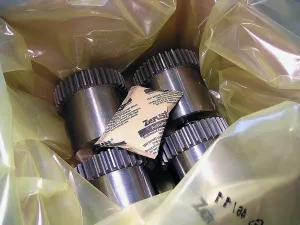
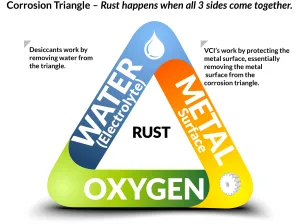
VCI emitters, also called VCI diffusers, protect metal components by releasing vapor corrosion-inhibiting molecules
into a sealed or enclosed space. To understand how do VCI emitters work, it’s important to know that these molecules disperse through the air and bond to exposed metal surfaces, where they form an invisible molecular layer that interrupts the electrochemical reactions responsible for rust and corrosion.
Unlike oils, greases, or coatings, VCI emitters do not require direct contact with the metal. Instead, they work through vapor-phase corrosion inhibition, making them especially effective for enclosed environments where traditional rust preventatives are difficult to apply or maintain.
How Do VCI Emitters Protect Metal Surfaces?
Once placed inside an enclosure, VCI emitters continuously release corrosion-inhibiting vapors at a controlled rate. These vapors migrate throughout the space to the metal surfaces. When they settle, they form a temporary protective barrier that blocks moisture, oxygen, and other corrosive elements from interacting with the metal.
Because this protective layer is molecular and self-renewing, it continues to protect metal components as long as the enclosure remains closed and the emitter remains active. When you open the enclosure, the VCI molecules dissipate naturally and leave the metal clean, dry, and ready for immediate use.
Where Are VCI Emitters Most Effective?
VCI emitters provide targeted corrosion protection in hard-to-reach or partially sealed environments where packaging alone may not be sufficient. Common applications include:
- Electrical enclosures and control panels
- Electronics cabinets and junction boxes
- Tool chests, cabinets, and storage lockers
- Shipping containers and crates
- Enclosures with complex geometries or airflow restrictions
In many cases, VCI emitters work alongside VCI films, papers, or bags to provide an extra layer of corrosion protection in demanding environments.
How Long Do VCI Emitters Continue to Work?
The effective lifespan of a VCI emitter depends on the product type, enclosure volume, and environmental conditions. Most emitters are designed to provide continuous corrosion protection for months or even years when used in properly sealed spaces.
Because they release inhibitors gradually and consistently, VCI emitters maintain a protective atmosphere without requiring frequent maintenance or reapplication.
Benefits
VCI emitters offer several advantages over traditional rust prevention methods:
- No oils, greases, or coatings to apply or remove
- No residue left on metal surfaces
- Continuous protection in enclosed spaces
- Effective for complex assemblies and multimetal systems
- Reduced labor and maintenance requirements
These benefits make VCI emitters a practical solution for both short-term storage and long-term equipment preservation.
Ready to strengthen corrosion protection?
Learn how VCI emitters can enhance protection in enclosed spaces and complex assemblies.
Can VCI Emitters Be Used With Other Corrosion Protection Products?
Yes. VCI emitters are often used as a complementary solution alongside other corrosion protection methods. For example, they can enhance protection inside packaged assemblies or shipping containers that already use VCI packaging materials.
This layered approach helps ensure consistent corrosion protection in the most extreme environments.
When to Use
VCI emitters are ideal when corrosion protection is needed in enclosed spaces that cannot be fully wrapped, bagged, or coated. They are commonly used for electronics, stored equipment, spare parts, and critical components that must remain clean and immediately operational.
Need help choosing the right solution?
For guidance on selecting the right VCI emitter or determining proper placement, ZERUST® technical support can help ensure optimal corrosion protection for your specific application.
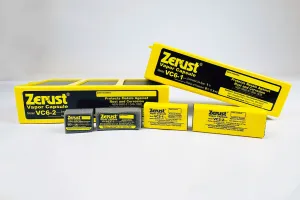
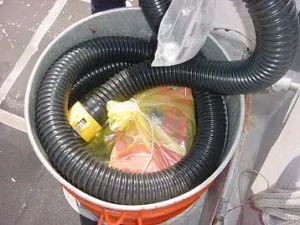


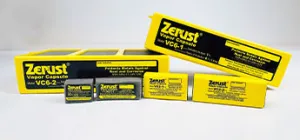
Vapor Capsules are portable VCI emitter diffusers containing proven ZERUST® Vapor Corrosion Inhibitors (VCI). They protect metals in hard-to-reach areas of control panels, electrical cabinets, or other enclosed spaces from corrosion, even when they are in operation. Additionally, use these VCI emitter diffusers as a supplement to other ZERUST® VCI packaging products for added protection.
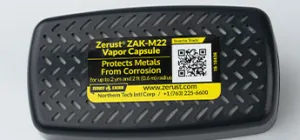
ZAK-M22 Vapor Capsules are portable VCI capsules containing proven ZERUST® VCI technology, used to protect metals in hard-to-reach areas of control panels, electrical cabinets, or any other enclosed spaces from corrosion. Each capsule has a QR code printed on the label to facilitate scheduling its replacement schedule.

ActivPak® is a versatile and powerful fast-acting VCI sachet designed to address flash rust and corrosion concerns in demanding scenarios, including overseas shipping and polluted factory environments.

ActivPak®(LS) Flash Corrosion VCI Emitters offer fast-acting corrosion protection in challenging conditions, such as factories, marine environments, waste treatment facilities, and power plants.

ActivCapsule™ FAC1-1(S) is a drop-in capsule containing proven ZERUST® Vapor Corrosion Inhibitor (VCI) technology used as a flash-corrosion prevention product to protect metals from corrosion in hard-to-reach areas in almost any enclosure or as a supplement to other ZERUST® VCI packaging products for added protection.
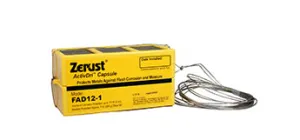
ActivDri™ FAD12-1 Desiccant VCI Capsule protects metals in hard-to-reach areas of enclosed spaces by utilizing Vapor Corrosion Inhibitors (VCIs) to prevent corrosion and a silica-gel desiccant to combat humidity that affects metals and electronics in corrosive environments such as salty air or power plants.


Cor Tab® are compressed drop-in VCI tablets that provide superior corrosion protection for metal surfaces and metal items in small or hard-to-reach areas of enclosures, such as electronic instruments, computer parts, small metal parts, inside tool chests, and more.

ICT® Plastabs® are thin, light, rigid polyethylene VCI emitter plastic tabs that are made with ZERUST® Vapor Corrosion Inhibiting (VCI) technology. Their small, thin shape makes Plastabs® perfect for protecting critical surfaces within narrow or hard-to-reach areas of electronics or parts of equipment or as a supplement to other ZERUST® VCI packaging products for added protection.

ICT® Tube Strip is a flexible hollow plastic VCI emitter tubing product containing ZERUST® Vapor Corrosion Inhibitor technology. They are used to protect narrow tubes, pipes, and other enclosed spaces from corrosion or as a supplement to other ZERUST® VCI packaging products for added protection.