When evaluating Cortec vs ZERUST®, many online results rely on manufacturer-generated claims instead of standardized testing. This page presents a data-driven review using recognized corrosion test methods and evaluations.

Understanding film performance requires more than brand claims. Test conditions, metal types, and exposure environments all influence results.

Cortec vs ZERUST® Quick Comparison Summary

Humidity & Cyclic Testing

ZERUST® showed no corrosion in multiple tests, while Cortec showed moderate to severe corrosion.

NACE TM0208 Results

ZERUST® achieved higher NACE VCI grades, including Grade 3, compared to Cortec Grades 1 and 2 in several evaluations.

Impact Resistance

ZERUST® high-strength film reached 874 grams at break, greatly exceeding Cortec’s 121 to 184 grams.

Overall Takeaway

Testing showed stronger and more consistent corrosion protection and durability with ZERUST®.

Why Cortec vs ZERUST® Results Can Be Misleading Online

Many published Cortec vs ZERUST® VCI film comparisons originate from internal testing conducted by Cortec. While these studies can provide insight, they often lack:

  • Standardized side-by-side conditions
  • Multi-source validation
  • Transparent methodologies
  • Equivalent material comparisons

As a result, performance claims may not reflect real-world conditions.

Therefore, evaluating Cortec vs ZERUST® VCI film performance requires independent-style testing using recognized industry standards.

Test Methods Used to Compare Cortec vs ZERUST®

To ensure a reliable VCI film comparison, multiple standardized test methods were used across different evaluations.

NACE TM0208 (VCI Efficacy Test)

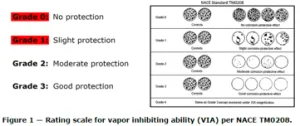
NACE TM0208, also known as the VCI jar test, evaluates the effectiveness of vapor corrosion inhibitors in enclosed environments. Cleaned metal samples are placed inside sealed containers along with the test material.

The setup allows VCI molecules to vaporize, diffuse, and interact with exposed metal surfaces under controlled corrosive conditions.

  • Vapor distribution
  • Off-contact protection
  • Molecular barrier formation

cortec vs zerust vci film NACE TM0208 grading scale corrosion protection levels

ASTM D1735 (Humidity Chamber Testing)

ASTM D1735 evaluates corrosion resistance in a controlled, high-humidity environment. Metal samples are exposed to continuous condensation at elevated temperatures.

This creates a highly corrosive condition that accelerates oxidation and allows rapid comparison of protective performance.

  • Continuous high humidity exposure
  • Condensation on metal surfaces
  • Accelerated corrosion conditions

IEC 60068-2-30 (Cyclic Environmental Testing)

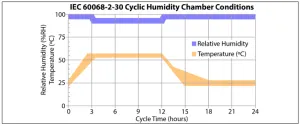
IEC 60068-2-30 evaluates performance under cyclic temperature and humidity conditions. Unlike static humidity testing, this method alternates between high humidity and drying phases.

It is especially useful for simulating storage and transport environments with changing conditions.

  • Repeated condensation cycles
  • Temperature and humidity swings
  • Durability over time

cyclic humidity temperature relative humidity test graph

These standardized methods provide a consistent framework for evaluating Cortec vs ZERUST® VCI film performance and help eliminate bias that can occur in non-standardized testing.

Understanding the VCI Jar Test

Learn how NACE TM0208 testing works and what results actually mean when comparing corrosion protection performance.

Read More

Cortec vs ZERUST® Test Results

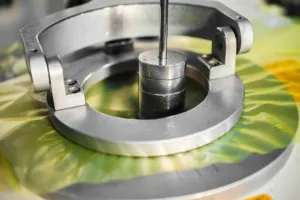
zerust vci film dart impact test ASTM D1709 puncture resistanceTo provide a transparent comparison, multiple real-world test scenarios were evaluated using standardized corrosion and mechanical test methods. These evaluations included both vapor corrosion protection and film durability to reflect real-world packaging performance.

In addition to corrosion testing, mechanical properties were analyzed to ensure each film could withstand handling, transport, and industrial use conditions.

Evaluated Mechanical Properties

Tensile Strength and Elongation (ASTM D882)

This test measures the force required to stretch a film until it breaks, as well as how much it can elongate before failure. It provides insight into film flexibility, strength, and resistance to tearing under tension during handling and packaging operations.

Tear Resistance (ASTM D1992 – Elmendorf Tear Test)

The Elmendorf tear test evaluates the force required to propagate a tear once it has started. A pendulum mechanism measures resistance as it tears through the film. This test is critical for understanding how well a film resists damage during handling, especially when small punctures or cuts occur.

Dart Impact Resistance (ASTM D1709)

This test measures the ability of a film to resist sudden impact from a free-falling dart. It simulates real-world conditions such as dropping tools or parts onto packaging. The result indicates how well the film resists puncture and failure under dynamic loads.

These combined test methods provide a more complete evaluation by measuring both corrosion protection and the physical durability required for industrial packaging applications.

Automotive Customer Testing

NACE TM0208 Jar Test

Test Result:
Samples were evaluated in sealed environments to assess vapor-phase corrosion protection under controlled conditions. Both films provided effective vapor-phase protection during testing. However, ZERUST® demonstrated cleaner metal surfaces in comparison, indicating a higher level of corrosion inhibition. No evidence was observed showing Cortec outperforming ZERUST® under these conditions.

cortec vs zerust vci film jar test corrosion comparison automotive customer

Dart Impact Resistance (ASTM D1709)

Test Result:
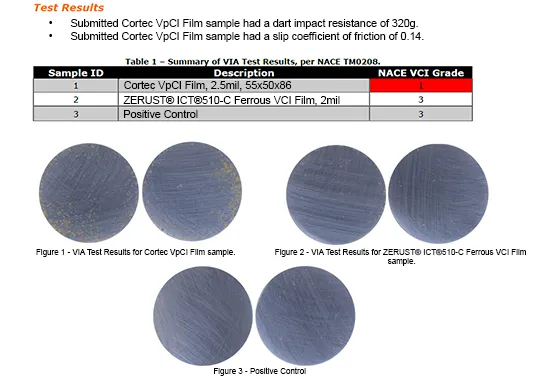
Samples were tested according to ASTM D1709 to evaluate resistance to sudden impact and puncture. Both films met the required impact resistance thresholds for industrial packaging applications. ZERUST® demonstrated comparable or improved puncture resistance relative to Cortec, with no performance disadvantage observed. These results indicate that both materials are suitable for applications requiring impact durability.

cortec vs zerust vci film dart impact resistance comparison ASTM D1709

Automotive OEM Testing

NACE TM0208 Jar Test

Test Result:
Both films provided effective vapor-phase corrosion protection during testing. ZERUST® demonstrated equal or improved corrosion prevention, with consistent performance observed across all samples. No evidence indicated superior performance by Cortec in this evaluation.
cortec vs zerust vci film NACE jar test OEM corrosion protection comparison

Industrial Knives and Blades Manufacturer

IEC 60068-2-30 Cyclic Humidity Test

Test Result:
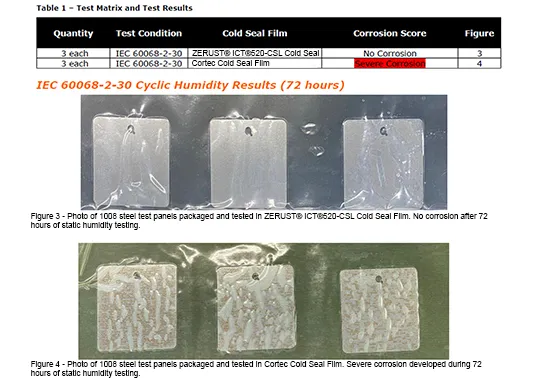
ZERUST® showed no corrosion after cyclic humidity exposure, while Cortec exhibited severe corrosion under the same test conditions. ZERUST® significantly outperformed Cortec.
cortec vs zerust vci film cyclic humidity corrosion severe vs no corrosion

ASTM D1735 Humidity Chamber Test

Test Result:
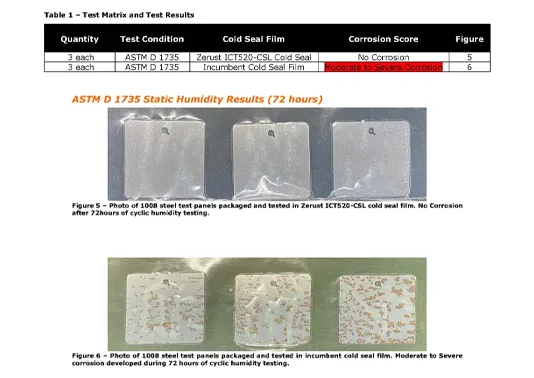
ZERUST® maintained corrosion-free performance, while Cortec showed moderate to severe corrosion under identical conditions. ZERUST® clearly outperformed Cortec.
cortec vs zerust humidity chamber corrosion comparison ASTM D1735 results

Packaging Distributor Testing

NACE TM0208 Jar Test

Test Result:
Both films provided vapor-phase corrosion protection. ZERUST® showed equal or improved performance, and no evidence indicated superior performance by Cortec in this evaluation.
cortec vs zerust vci film jar test packaging distributor comparison

Extruder Testing

NACE TM0208 Jar Test

Test Result:
ZERUST® demonstrated complete corrosion protection with clean metal surfaces, while Cortec exhibited corrosion during testing under identical conditions. ZERUST® significantly outperformed Cortec in this evaluation.
cortec vs zerust vci film extruder jar test corrosion comparison

Industrial Supply Distributor F

NACE TM0208 Jar Test

Test Result:
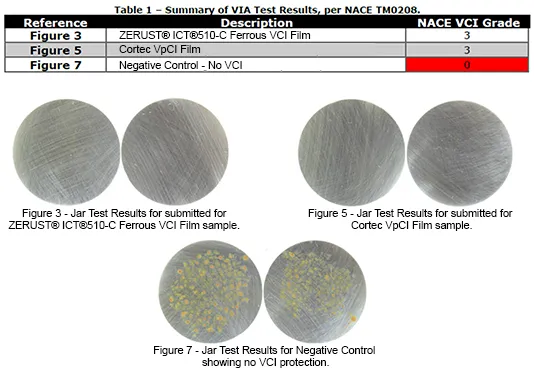
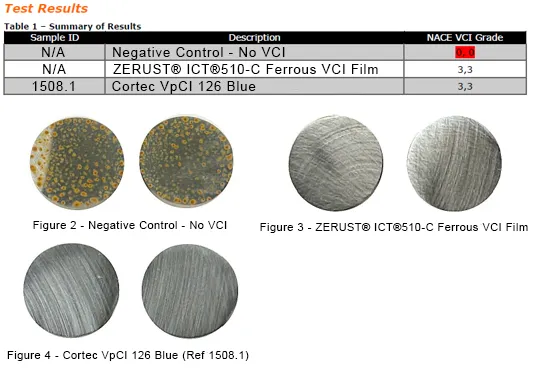
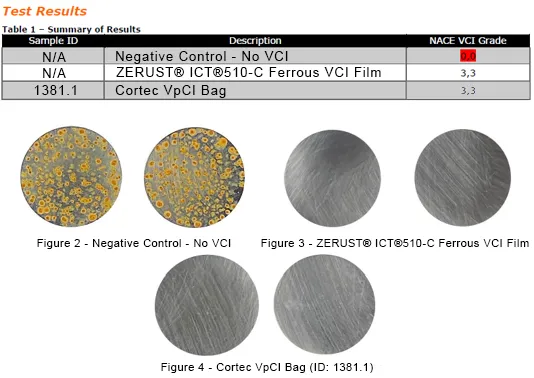
ZERUST® achieved a NACE VCI Grade 3, demonstrating effective corrosion inhibition. Cortec received a NACE VCI Grade 1, indicating significant corrosion presence. Based on NACE grading, ZERUST® significantly outperformed Cortec in this test.
cortec vs zerust vci film NACE grade 3 vs grade 1 corrosion comparison

Dart Impact Resistance (ASTM D1709)

Test Result:
Both films demonstrated mechanical performance suitable for industrial packaging use in this evaluation.

Industrial Supply Distributor SD

NACE TM0208 Jar Test

Test Result:
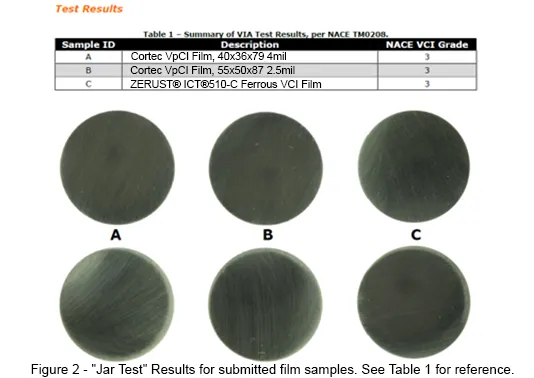
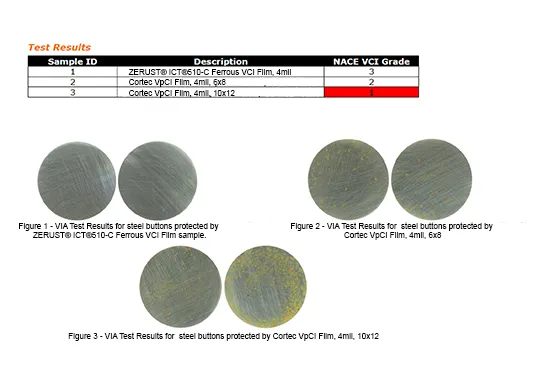
ZERUST® achieved a NACE VCI Grade 3, demonstrating effective corrosion inhibition. Cortec received NACE VCI Grades 1 and 2, indicating corrosion presence and lower protection performance. Based on NACE grading, ZERUST® significantly outperformed Cortec in this test.
cortec vs zerust vci film NACE grade comparison distributor SD results

Automotive Supplier and Manufacturer Testing

ASTM D1735 Static Humidity Chamber

Test Result:
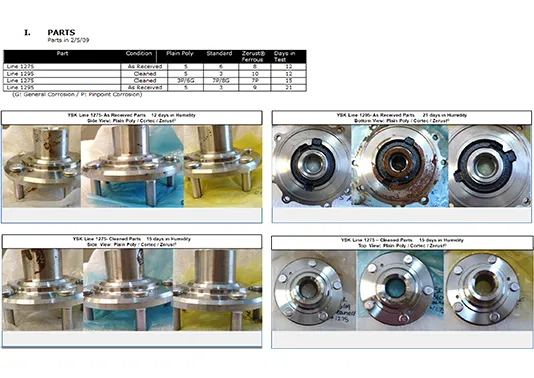
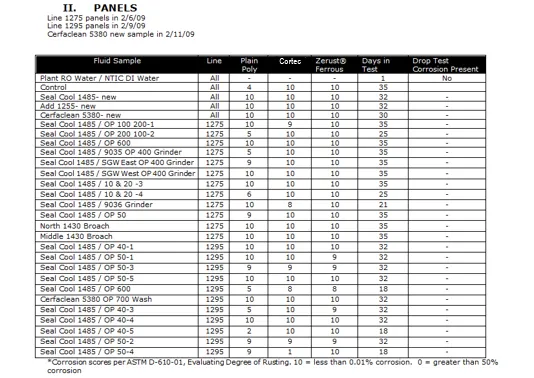
ZERUST® maintained effective corrosion protection throughout the duration of testing, while Cortec exhibited progressive corrosion under identical conditions. At 12, 15, and 21 days, ZERUST® demonstrated significantly better corrosion resistance than Cortec.
cortec vs zerust humidity chamber long term corrosion test 12 15 21 days
Automotive supplier humidity chamber extended test comparison

FTM STD 101C M4031 (NACE TM0208 Equivalent)

Test Result:
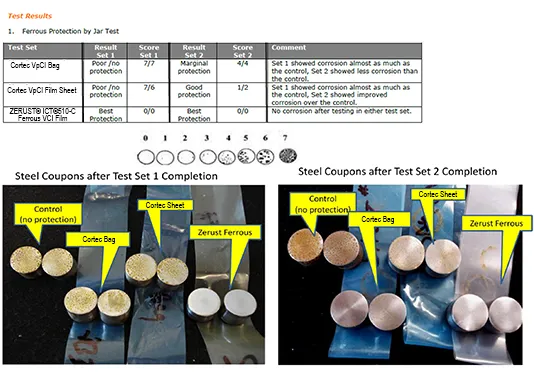
Cortec sheeting exhibited corrosion levels similar to the control in test set 1 and only partial improvement in test set 2. Cortec bag samples followed a similar trend, with corrosion comparable to the control in test set 1 and reduced corrosion in test set 2. ZERUST® demonstrated complete corrosion protection with no corrosion observed in either test set. Relative to both Cortec and the control, ZERUST® delivered superior corrosion inhibition.
cortec vs zerust vci film control comparison corrosion jar test results

ASTM D882 Tensile Strength & Elongation

Test Result:
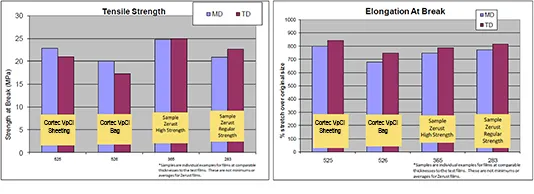
ZERUST® high-strength film achieved approximately 25 MPa tensile strength, outperforming Cortec sheeting at 21–22 MPa and Cortec bag film at 17–20 MPa. ZERUST® standard film matched Cortec sheeting at approximately 21–22 MPa. ZERUST® films demonstrated elongation at break ranging from approximately 750–810%, while Cortec sheeting ranged from 800–850% and Cortec bag film ranged from 675–750%. Overall, ZERUST® films delivered higher tensile strength with competitive elongation, providing a more balanced mechanical performance profile.
vci film tensile strength elongation ASTM D882 comparison

ASTM D1709 Dart Impact Strength

Test Result:
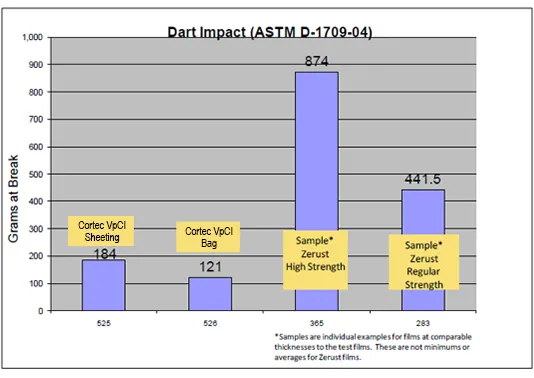
ZERUST® high-strength film achieved approximately 874 grams at break, greatly exceeding Cortec sheeting at 184 grams and Cortec bag film at 121 grams. ZERUST® standard film achieved approximately 441.5 grams at break, more than doubling the performance of Cortec sheeting. These results demonstrate that ZERUST® films provide substantially higher puncture resistance and durability under impact conditions.
dart impact strength ASTM D1709 comparison

ASTM D1992 Tear Resistance

Test Result:
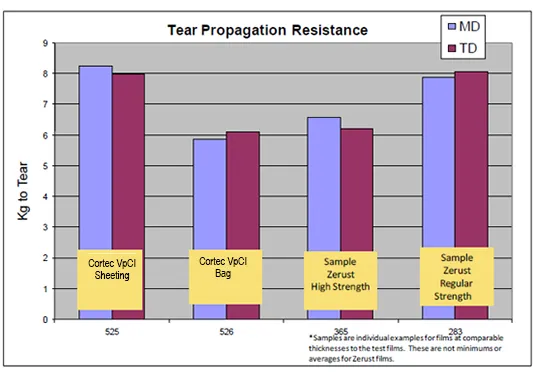
Tear resistance was comparable between the films in this evaluation, indicating both materials were suitable for industrial handling conditions.
vci film tear resistance ASTM D1992 comparison

When VCI Testing Isn’t Enough

Jar testing is valuable, but it doesn’t tell the whole story. Learn what additional factors impact real-world corrosion protection.

Learn More

Cortec vs ZERUST® Performance Comparison

Test Type ZERUST® Cortec
IEC 60068-2-30 No corrosion Severe corrosion
ASTM D1735 No corrosion Moderate to severe corrosion
NACE TM0208 Grade 3 Grade 1 to 2
ASTM D1709 Dart Impact 441.5 to 874 g 121 to 184 g

Cortec vs ZERUST® Key Findings

Stronger Corrosion Protection

ZERUST® demonstrated no corrosion in several humidity and cyclic exposure tests, while Cortec showed moderate to severe corrosion.

Higher NACE Grades

ZERUST® achieved stronger NACE TM0208 results in multiple evaluations, showing more effective vapor-phase protection.

Superior Impact Resistance

ASTM D1709 testing showed substantially higher dart impact strength with ZERUST® films.

Balanced Mechanical Performance

ZERUST® films delivered strong tensile performance with competitive elongation and durability.

These results demonstrate that ZERUST® provides more reliable corrosion protection and superior mechanical durability under a wide range of real-world conditions.

Cortec vs ZERUST® Yellow Metal Protection Results

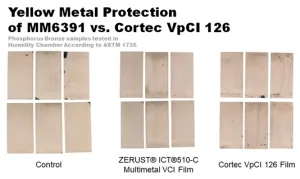
cortec vs zerust vci film yellow metal corrosion test phosphorus bronze comparisonOne common claim is that Cortec provides superior multimetal protection. However, testing on yellow metals such as phosphorus bronze showed:

  • Comparable protection between the two films
  • Instances where ZERUST® provided improved corrosion resistance
  • No consistent advantage for Cortec across all metal types

This highlights the importance of evaluating specific application environments rather than relying on generalized claims.

What Defines a Reliable VCI Film Comparison Between Cortec vs ZERUST®

  • Identical test conditions
  • Same metal types and preparation
  • Equivalent film thickness and formulation type
  • Standardized test methods such as NACE TM0208 and ASTM D1735
  • Transparent reporting of results

Many publicly available comparisons do not meet these criteria, leading to misleading conclusions.

Cortec vs ZERUST® Real-World Application Considerations

  • Packaging seal integrity
  • Environmental humidity and temperature changes
  • Metal cleanliness and dryness
  • Exposure to chlorides or contaminants

Even the highest-performing VCI film will fail if these conditions are not controlled.

Cortec vs ZERUST® VCI Film Conclusion

  • Cortec and ZERUST® VCI films deliver comparable corrosion protection in some applications
  • ZERUST® demonstrated superior performance in select conditions
  • No consistent evidence supports claims of universal Cortec superiority

For most industrial applications, selecting the right VCI solution should focus on application design, not brand assumptions.

Choosing the Right VCI Supplier

Beyond product performance, learn what to evaluate when selecting a corrosion protection partner and how to ensure reliable results in real-world applications.

Read Guide

Tom White

Tom White is the Marketing Manager at ZERUST®, bringing nearly a decade of experience in Vapor Corrosion Inhibitor (VCI) technologies and corrosion prevention solutions. He holds a degree in marketing from St. Cloud State University and specializes in translating complex technical solutions into clear, effective messaging that resonates with industrial audiences.

In his role, Tom leads strategic marketing initiatives that promote ZERUST®’s global product portfolio, including sustainable VCI packaging films, rust preventative coatings, and industrial cleaning solutions. He works closely with technical teams, sales leaders, and international partners to ensure that product positioning aligns with real-world applications and customer needs across industries such as manufacturing, transportation, and infrastructure.

Tom is actively involved in product launches, trade show planning, digital marketing strategy, and content development. His work focuses on connecting ZERUST®’s corrosion prevention technologies with engineers, manufacturers, and decision-makers who rely on effective asset protection and operational reliability.

With a strong emphasis on customer engagement and market insight, Tom helps bridge the gap between technical expertise and business impact. He supports initiatives that highlight how corrosion prevention improves equipment lifespan, reduces downtime, and contributes to more sustainable operations.

Through his contributions to the ZERUST® blog, Tom shares insights on corrosion prevention strategies, industry trends, and product applications. His content is designed to educate and inform while helping organizations identify the right solutions to protect valuable metal assets and optimize long-term performance.

Discover Proven Corrosion Prevention Solutions

Explore ZERUST® technologies designed to protect your metal assets, improve reliability, and support long-term performance.

Close