How the Concentration Effect Causes Metalworking Fluid Corrosion
Metalworking fluid corrosion can develop when the chemistry of a fluid changes during use. One of the most common causes of this problem is known as the concentration effect.
Most people have seen a similar effect in everyday life. For example, imagine a kitchen sink filled with soapy water used to wash dishes. As more dishes are washed, the water becomes dirtier and less effective. The soap is gradually depleted while contaminants such as grease, food particles, and oil accumulate.
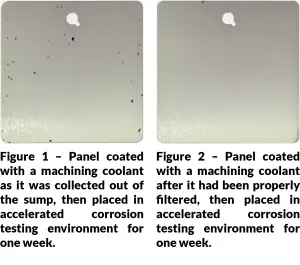
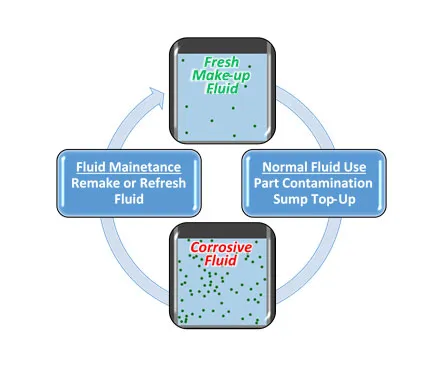
A similar process occurs in metalworking fluids. As the fluid continues to be used, beneficial chemistry is slowly consumed while contamination steadily increases. Over time, this imbalance can create conditions that promote metalworking fluid corrosion on metal parts and equipment.
This buildup of contamination, combined with the depletion of protective additives, is the core of the concentration effect.
How the Concentration Effect Changes Metalworking Fluids
The concentration effect is one of the leading causes of contamination buildup in metalworking fluids. Fluids that are diluted with water are especially susceptible because water quality and operating conditions can significantly influence the chemistry of the system.
Most metalworking fluids are designed to tolerate a certain amount of contamination. However, if the system is not properly maintained, corrosive contaminants can eventually overwhelm the protective chemistry within the fluid.
When this occurs, several problems can develop:
Residues left by lubricants may become corrosive
Wash fluids may lose their ability to properly clean parts
Rust preventative additives may no longer protect metal surfaces
As a result, metal components processed with the fluid may become vulnerable to metalworking fluid corrosion, leading to rust, staining, or surface degradation.
Maintaining the correct chemical balance in the fluid is therefore critical for preventing corrosion during machining, cleaning, and part-handling operations.
Protect Your Parts During Machining and Cleaning
Corrosion caused by contaminated metalworking fluids can damage parts and increase production costs. ZERUST® corrosion protection solutions help manufacturers prevent rust and maintain part quality throughout machining, cleaning, and storage.
How to Prevent Metalworking Fluid Corrosion from the Concentration Effect
Fortunately, the concentration effect can be minimized with proper fluid management and maintenance practices.
One of the most important steps is using high-quality water, such as deionized or reverse osmosis water, when preparing or replenishing metalworking fluids. High-quality water reduces the introduction of unwanted ionic contamination that can accelerate corrosion.
Another important practice involves how fluids are topped off during normal operation. When evaporation or drag-out losses occur, straight water should not be added directly to the system. Instead, a low concentration mixture of the metalworking fluid should be used. This approach helps restore the beneficial chemistry that is gradually consumed during the fluid’s life cycle.
In addition, regular monitoring and maintenance are critical. Facilities should implement:
Routine fluid analysis
Scheduled sump maintenance
Detailed fluid management logs
These practices help detect changes in fluid chemistry before they become severe enough to cause metalworking fluid corrosion or part damage.
With consistent monitoring and proper fluid management, manufacturers can maintain fluid performance while protecting metal components from corrosion.
Partner with ZERUST®
Managing metalworking fluid corrosion requires more than simply selecting the right fluid. Fluid chemistry, water quality, maintenance practices, and production conditions all influence corrosion risk throughout the manufacturing process. ZERUST® corrosion specialists work directly with manufacturers to evaluate their metalworking operations, identify potential corrosion sources, and recommend the most effective protection strategies. By combining process knowledge with proven corrosion prevention technologies, ZERUST® helps companies reduce corrosion caused by metalworking fluids while improving part quality, reliability, and overall operational efficiency.
Need Help Preventing Metalworking Fluid Corrosion?
ZERUST® corrosion specialists can help you evaluate your metalworking fluids, process conditions, and maintenance practices to identify solutions that reduce corrosion risk and protect your metal components throughout production, storage, and shipment.
Daniel Neuburger is the Technical Service Manager at ZERUST®, where he specializes in developing tailored corrosion prevention solutions that address complex challenges across a wide range of industrial applications.
In his role, Daniel works directly with manufacturers, engineers, and maintenance teams to evaluate corrosion risks, assess environmental conditions, and design practical strategies that protect metal assets throughout production, storage, and shipment. His hands-on approach ensures that corrosion control solutions are not only technically effective but also easy to implement in real-world operating environments.
Daniel has extensive experience supporting industries such as manufacturing, transportation, heavy equipment, and infrastructure. He provides guidance on the use of ZERUST® Vapor Corrosion Inhibitor (VCI) packaging, rust preventative coatings, and water-based corrosion control technologies to help organizations improve reliability, extend equipment lifespan, and reduce costly downtime.
A key focus of Daniel’s work is helping customers enhance operational efficiency while minimizing material waste and supporting sustainability goals. By optimizing corrosion prevention programs, he helps organizations reduce rework, lower maintenance costs, and improve overall productivity.
Known for his problem-solving mindset and technical expertise, Daniel collaborates closely with customers to troubleshoot corrosion issues, refine processes, and deliver measurable results. Through his contributions to the ZERUST® blog, he shares practical insights, application-driven guidance, and best practices that help readers strengthen their corrosion prevention strategies and protect valuable assets across global operations.
Need Help Solving a Corrosion Challenge?
Connect with ZERUST® experts to develop customized corrosion prevention strategies that improve performance and protect your assets.
AxxaWash™ KF-121 is a low foam, alkaline, water-based metal cleaner that effectively removes light to medium-duty hydrocarbon soils from ferrous substrates. Additionally, it also serves as the ideal metal cleaner for applications requiring low temperatures.
AxxaWash™ KF-122 is a low-foaming, heavy-duty alkaline, water-based cleaner compatible with very hard water in a wide range of operating temperatures. Additionally, it also maintains low foaming under spray conditions.
ZERUST®/EXCOR® AxxaWash™ KF-123 is a low-foaming, mildly alkaline, high-performance water-based industrial parts washer that is designed for cleaning ferrous substrates. In addition, AxxaWash™ KF-123 provides flash-rust inhibition.
AxxaWash™ KF-124 is a low-foaming, mildly alkaline, water-based degreaser & cleaner with low operating temperatures. In addition to cleaning, AxxaWash™ KF-124 provides flash-rust inhibition.
AxxaWash™ KMS-220 is a low foam, low temperature, mildly alkaline water-based part cleaner with excellent oil-splitting capabilities. In addition, AxxaWash™ KMS-220 provides flash-rust inhibition.
AxxaWash™ KMS-305AL is a low foam, low temperature, alkaline water-based aluminum part cleaner designed for use with aluminum and ferrous metals in spray systems with its excellent oil-splitting capabilities.
AxxaWash™ KMS-310AL is a low-foaming, alkaline, water-based aluminum and ferrous cleaner that’s designed to be used in immersion, ultrasonic, spray, or drum washer processes.
AxxaWash™ NW-10C is a mildly alkaline, water-based preservation cleaner with a wide range of operating temperatures. In addition to flash-rust inhibition, it also removes and deactivates sources of corrosion such as chlorides, oils, and contaminants.
AxxaWash™ NW-12C is a mildly alkaline, water-based ultrasonic cleaning solution with a wide range of operating temperatures. In addition, it can be used in immersion and spray cleaning modes.
To provide the best experiences, we use technologies like cookies to store and/or access device information. Consenting to these technologies will allow us to process data such as browsing behavior or unique IDs on this site. Not consenting or withdrawing consent, may adversely affect certain features and functions.
Functional
Always active
The technical storage or access is strictly necessary for the legitimate purpose of enabling the use of a specific service explicitly requested by the subscriber or user, or for the sole purpose of carrying out the transmission of a communication over an electronic communications network.
Preferences
The technical storage or access is necessary for the legitimate purpose of storing preferences that are not requested by the subscriber or user.
Statistics
The technical storage or access that is used exclusively for statistical purposes.The technical storage or access that is used exclusively for anonymous statistical purposes. Without a subpoena, voluntary compliance on the part of your Internet Service Provider, or additional records from a third party, information stored or retrieved for this purpose alone cannot usually be used to identify you.
Marketing
The technical storage or access is required to create user profiles to send advertising, or to track the user on a website or across several websites for similar marketing purposes.
To provide the best experiences, we use technologies like cookies to store and/or access device information. Consenting to these technologies will allow us to process data such as browsing behavior or unique IDs on this site. Not consenting or withdrawing consent, may adversely affect certain features and functions.
Functional
Always active
The technical storage or access is strictly necessary for the legitimate purpose of enabling the use of a specific service explicitly requested by the subscriber or user, or for the sole purpose of carrying out the transmission of a communication over an electronic communications network.
Preferences
The technical storage or access is necessary for the legitimate purpose of storing preferences that are not requested by the subscriber or user.
Statistics
The technical storage or access that is used exclusively for statistical purposes.The technical storage or access that is used exclusively for anonymous statistical purposes. Without a subpoena, voluntary compliance on the part of your Internet Service Provider, or additional records from a third party, information stored or retrieved for this purpose alone cannot usually be used to identify you.
Marketing
The technical storage or access is required to create user profiles to send advertising, or to track the user on a website or across several websites for similar marketing purposes.

 Metalworking fluid corrosion can develop when the chemistry of a fluid changes during use. One of the most common causes of this problem is known as the concentration effect.