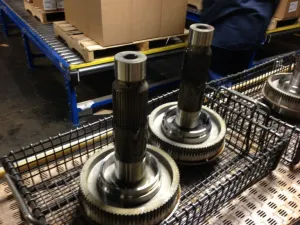
Can VCI bags be used with solvent coatings? This is a common question for manufacturers and exporters who already use solvent-based rust preventatives and want to confirm compatibility with ZERUST®/EXCOR® VCI bags and VCI film. In most cases, VCI bags can be used with solvent coatings, provided the coating is applied correctly and allowed to fully dry before packaging. The sections below provide a more in-depth explanation, including best practices, potential limitations, and guidance on when combining solvent coatings with VCI packaging is appropriate.
How Solvent Coatings Work with VCI Packaging
Solvent-based rust preventatives protect metal surfaces by leaving behind a thin, protective film once the solvent carrier evaporates. When applied correctly, this thin residual layer does not interfere with the performance of VCI packaging.
ZERUST®/EXCOR® VCI technology works by releasing corrosion-inhibiting vapor molecules that migrate throughout the sealed package and adsorb onto exposed metal surfaces. These molecules form a molecular-level protective layer that interrupts the corrosion process.
When solvent coatings are:
- Applied at the correct thickness, and
- Allowed to dry before packaging fully
VCI vapor molecules can still effectively reach the metal surface and provide corrosion protection.
When Solvent Coatings May Affect VCI Performance
Problems can arise when solvent coatings are overapplied or not fully dried prior to sealing the package.
Potential issues include:
- Excessively thick coatings create a physical barrier that limits VCI access to the metal surface
- Trapped solvent vapors inside the package if coatings are sealed before drying
- Pooling or dripping coatings in crevices, which may reduce uniform VCI coverage
In these situations, the corrosion-inhibiting vapor molecules may not be able to reach the metal surface, reducing the overall effectiveness of the VCI packaging.
Best Practices for Using Solvent Coatings with VCI Bags
To ensure optimal corrosion protection when combining solvent coatings with VCI packaging, follow these best practices:
- Apply solvent-based rust preventatives in a thin, uniform layer
- Allow coatings to fully dry and cure before placing parts into VCI bags
- Ensure VCI packaging is properly sealed after parts are fully dry
- Use VCI bags sized appropriately for the package volume and metal surface area
Do You Always Need Both a Coating and VCI?
Not always. In many applications, VCI packaging alone provides sufficient protection and eliminates the need for solvent coatings altogether. In other cases, such as long-term storage, export shipments, or harsh environments, a combined system may be appropriate.
Selecting the right corrosion protection approach depends on:
- Metal type
- Storage or transit duration
- Environmental exposure (humidity, temperature, salt air, etc.)
- Handling and cleanliness requirements
Not Sure If Your Solvent Coating Is Compatible with VCI Packaging?
Solvent-based rust preventatives vary widely in chemistry, coating thickness, and drying behavior.
Our corrosion specialists can help determine whether your coating will work effectively with
ZERUST®/EXCOR® VCI bags or if an alternative approach is recommended.
Application-Specific Guidance
Because solvent coatings vary widely in chemistry, film thickness, and drying behavior, compatibility should be evaluated on a case-by-case basis.
Contact ZERUST®/EXCOR® to confirm:
- Suitability of a specific solvent-based rust preventative
- Recommended application thickness and drying time
- Whether a coating is necessary for your application at all
- The optimal VCI bag or film for your metal and environment
Our corrosion specialists can help design a complete corrosion-inhibiting system tailored to your operation.
Need an application-specific corrosion management system?
ZERUST®/EXCOR® corrosion specialists can evaluate your metal, environment, and process conditions to design a complete corrosion-inhibiting system optimized for your application.


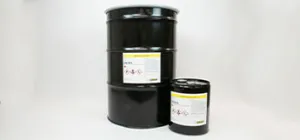
Axxanol™ 33CD is a solvent-based rust preventative that forms a dry-to-touch film, eliminating oily surfaces that attract dust and other contaminants.
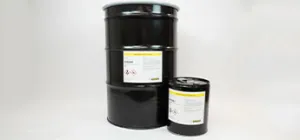
Axxanol™ 33CD-HF is a solvent-based high-flash corrosion inhibitor coating that dries-to-touch, eliminating oily surfaces that attract dust and other contaminants.
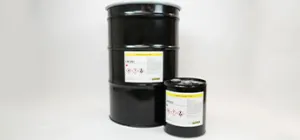
Axxanol™ 34CD is a solvent-based coating that forms a very light, oily, near dry-to-touch rust preventative film that provides powerful corrosion protection against aggressive environments.
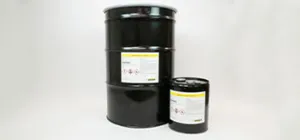
Axxanol™ 34CD-HF is a solvent-based high-flash rust preventative coating that forms a very light, oily film that is near dry-to-touch, providing powerful corrosion protection against aggressive environments, such as salt air and humidity.
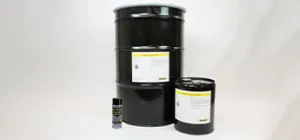
Axxanol™ A35CD-7 is a high-flash solvent-based rust preventative that forms a clear, thin, dry-to-touch film. As a result, it eliminates oily surfaces that attract dust and other contaminants.
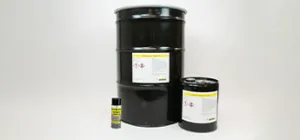
Axxanol™ A35CD-32 is a solvent-based, non-staining rust preventative that forms a clear, thin, near dry-to-touch RP film. As a result, it provides powerful corrosion protection against aggressive environments, such as salt air and humidity.